Why Thin YouTube Descriptions Are Quietly Killing Your Channel's Growth
Thin YouTube descriptions cost you viewers, rankings, and suggested placements. Learn the exact structure that helps videos rank for more keywords.
Why Thin YouTube Descriptions Are Quietly Killing Your Channel's Growth
Most creators write a title, skip the description, and wonder why their videos plateau. Here's the SEO concept behind it, why it costs you real viewers, and exactly how to fix it.
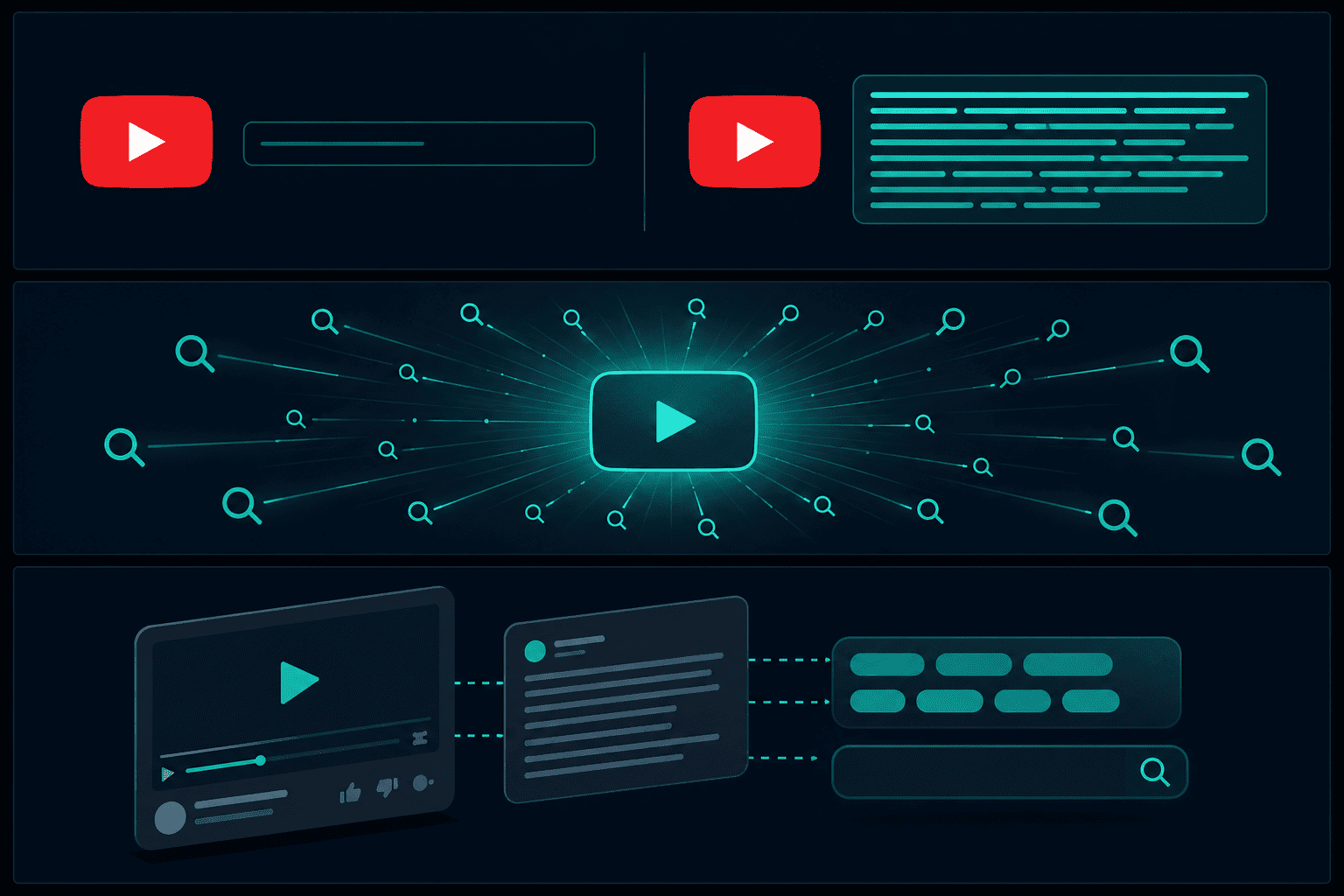
If you publish a video with just a title and nothing else, you're not just leaving views on the table — you're actively telling YouTube's algorithm and Google's search index that your video has almost no context to match against anyone's search. This is the same "thin content" problem that hurts websites in Google Search, just applied to video. And it's fixable in under ten minutes per upload.
What "Thin Content" Means on YouTube
In Google Search, "thin content" refers to pages with little substantive text — nothing for the search engine to meaningfully index or rank. On YouTube, the equivalent is a video upload where the metadata (title, description, tags) carries almost no information. Even a genuinely great video can underperform if its metadata gives the algorithm nothing to work with. YouTube's system doesn't understand your video's content directly at scale — it leans on the words around it.
How a Missing Description Actually Loses You Viewers
Here's what happens, concretely, when you skip the description:
- 🔍 You lose YouTube search matches — your video only ranks for the exact words in your title, instead of every related phrase a viewer might actually type
- 🌐 You lose Google Search visibility — Google indexes YouTube video descriptions and can surface your video for web searches, not just YouTube-internal searches. No description means nothing for Google to match
- 🔁 You lose "suggested video" placement — the algorithm uses description text (alongside watch patterns) to decide which videos are topically similar enough to recommend next to yours
- 🏷️ You lose long-tail keyword traffic — a single video can realistically rank for 10–30 related search phrases if the description supports them; a title-only upload might rank for one
- 📌 You lose retention tools — no timestamps means no chapter markers, so viewers who wanted one specific part just leave instead of skipping to it
The Core SEO Concept: Metadata Is Your Ranking Surface
Think of your title, description, and tags as the only "readable" version of your video that a search engine has access to. The richer and more accurately keyword-matched that text is, the more search queries your video becomes eligible to rank for. This works the same way a blog post ranks for many keywords, not just the one in its headline — because the body text supports dozens of related phrases.
The Description Structure That Actually Ranks
A strong description isn't just "more text" — it's structured so both the algorithm and human viewers get what they need in the first few seconds.
1. First 2–3 Lines (Above the "Show More" Fold)
Only the first ~100–150 characters show before a viewer has to click "more." This is prime real estate — write a natural sentence that includes your main keyword, not a generic intro.
❌ Weak: "New video! Hope you enjoy, don't forget to like and subscribe."

✅ Strong: "Learn how to fix Next.js hydration errors caused by
Date(), browser extensions, and window checks — with real code fixes
for each root cause."
2. Full Keyword-Rich Summary (200–400 words)
Expand on what the video covers using natural language variations of your target keyword — not the same phrase repeated, but the way real people phrase the same search intent differently.
3. Timestamps / Chapters
00:00 Intro
01:12 Why hydration errors happen
03:45 Fix 1: Date() and Math.random()
06:20 Fix 2: Browser extensions
08:50 Fix 3: window/localStorage checks
11:30 Fix 4: Invalid HTML nesting
Timestamps double as extra keyword text (each chapter title is searchable) and directly improve retention, since viewers can jump to the exact part they need instead of leaving.
4. Relevant Links and Hashtags
Link to related videos, your website, or resources mentioned — this builds topical authority and keeps viewers inside your ecosystem. Add 2–3 relevant hashtags at the end (not 15 — that reads as spam and can bury the ones that matter).
It's Not Just the Description — The Whole Metadata Set Matters
- 🏷️ Tags: still help YouTube understand context and misspellings/variants of your topic, even though their ranking weight has decreased over the years
- 📝 Closed captions/transcript: YouTube can index your spoken words too — accurate captions effectively multiply your searchable text
- 🖼️ Thumbnail + title pairing: gets you the click; description and captions get you the ranking. You need both — good metadata without a compelling thumbnail still won't get clicked
- 📌 Pinned comment: a good pinned comment with a question or link adds engagement signals, which indirectly help distribution
Pre-Publish Checklist
- ✅ First 2–3 lines of the description include your main keyword naturally
- 🔍 Full description is 200+ words and covers related search phrases, not just one repeated keyword
- 🕒 Timestamps/chapters added for anything over 3–4 minutes long
- 🔗 Links to related videos, playlists, or your site included
- 🏷️ 2–3 relevant hashtags, not a spam list
- 📝 Auto-captions reviewed and corrected, not left as raw auto-transcription
Frequently Asked Questions
❓ Does a longer description always rank better?
No — length alone doesn't help. A 400-word description packed with genuinely relevant keyword variations outperforms a 1,000-word description that's vague or repetitive. Depth and relevance matter more than word count.
❓ Can keyword stuffing in the description hurt me?
Yes. Repeating the same keyword unnaturally reads as spam to both viewers and YouTube's systems, and can suppress rather than help visibility. Write for humans first; the keyword coverage should feel natural.
❓ Is it worth fixing descriptions on old videos, or only new uploads?
It's worth doing both. Older videos with existing watch history and some initial ranking can often see a real bump from an upgraded description, since you're adding ranking surface to a video that already has some algorithmic trust.
A title gets you one shot at one search phrase. A well-structured description turns the same video into a magnet for dozens of related searches — the algorithm can only work with what you give it.