DA Score Won't Save You: Why E-E-A-T and Real Content Quality Actually Rank
A high DA score won't fix weak content. See why E-E-A-T, real experience, and quality content are what actually drive Google rankings in 2026.
DA Score Won't Save You: Why E-E-A-T and Real Content Quality Actually Rank
A practical breakdown of why Domain Authority alone won't rank your content — and how E-E-A-T, real experience, and genuinely useful content actually do.
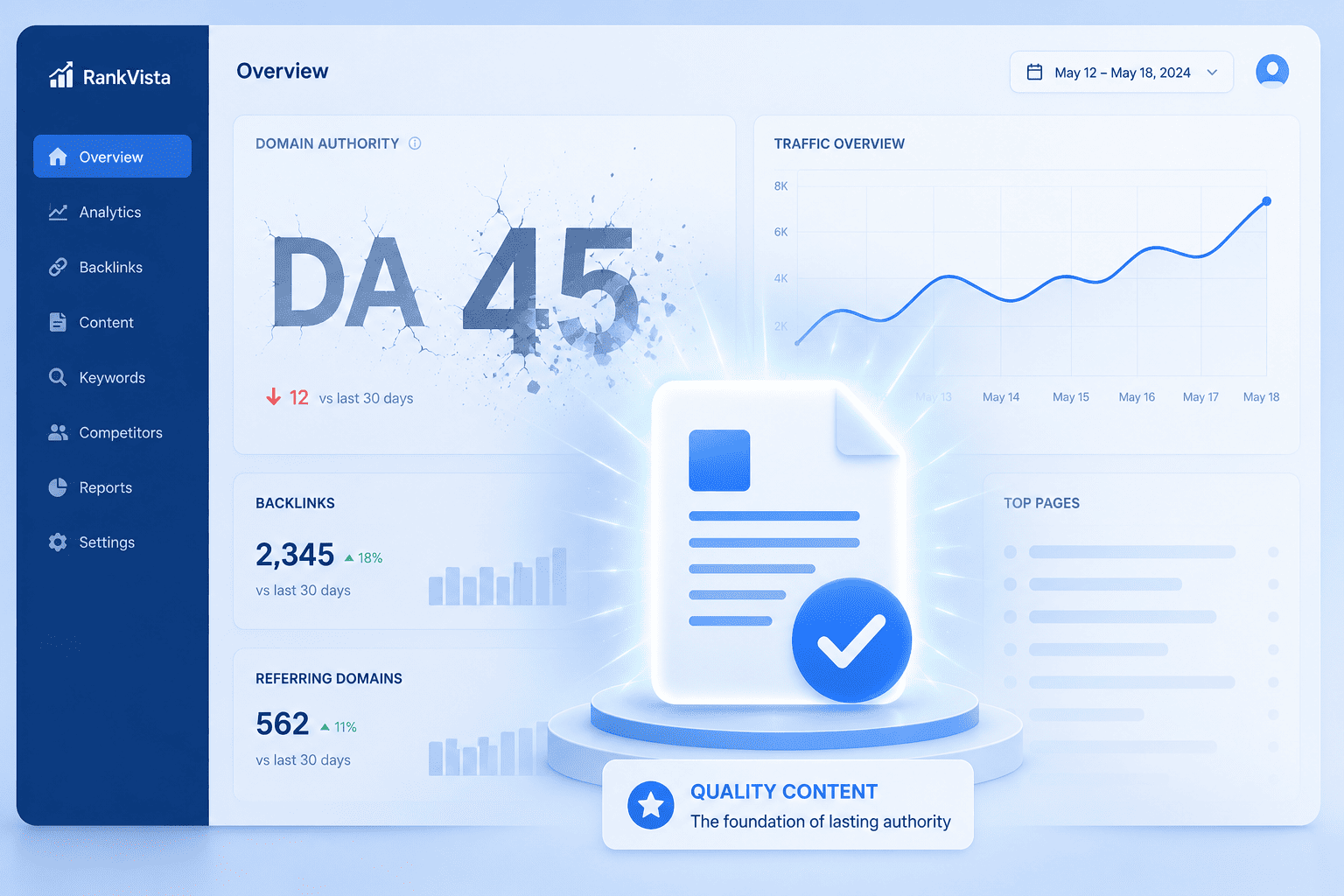
If you're chasing a high Domain Authority (DA) score as your primary SEO goal, you're optimizing for the wrong scoreboard. A DA 20 blog post that answers the reader's question with real expertise will consistently outrank a DA 60 page filled with generic, recycled content. DA doesn't rank pages — E-E-A-T and content quality do.
What DA Actually Measures
DA estimates how likely a site is to rank, based purely on backlink profile strength and quantity. It's useful for competitive research and benchmarking — but it's a proxy metric, not something Google's ranking systems read or reward directly.
Common Misconceptions
- 🔢 "My DA is 50, I should outrank DA 20 sites." — False. Relevance and depth win per query.
- 🔗 "More backlinks always mean better rankings." — One in-depth, well-sourced article can outperform ten backlink-heavy pages.
- 📊 "DA reflects Google's opinion of my site." — DA is calculated independently by Moz, not Google's index.
Why E-E-A-T Is the Metric That Actually Matters
E-E-A-T (Experience, Expertise, Authoritativeness, Trustworthiness) is the framework Google's Search Quality Raters use to evaluate content — and it increasingly correlates with how the core algorithm treats pages, especially in YMYL niches like finance, health, and technical advice.
The Four Pillars
- Experience: Have you actually done the thing you're writing about?
- Expertise: Do you explain not just "what" but "why" and "when it fails"?
- Authoritativeness: Do credible sources reference your work naturally?
- Trustworthiness: Is your content accurate, transparent, and honest about limitations?
A Practical Comparison
Imagine two articles targeting "best caching strategy for Node.js APIs":
- Article A: Generic Redis summary, no benchmarks, no author credentials.
- Article B: Real latency numbers — e.g., reduced average response time from 340ms to 45ms using Redis with a 5-minute TTL — plus a linked repo and discussion of cache invalidation bugs actually debugged.
Article B wins. Not because of DA — because it demonstrates lived experience that thin or AI-generated content can't replicate.
High-Quality Content Beats Random Content Every Time
Google's helpful content systems are built to demote content written primarily for search engines rather than people.
Random Content Looks Like
- 🚫 Keyword-stuffed pages with no unique insight
- 🚫 Rehashed summaries of the top 3 search results
- 🚫 Thin posts published just to hit a word count
High-Quality Content Looks Like
- ✅ Original data, case studies, or personal project outcomes
- ✅ Answer-first structure that satisfies intent within the first 100 words
- ✅ Depth covering edge cases and practical next steps
- ✅ Code samples, screenshots, or visuals proving the claims
Experience Is Your Unfair Advantage
As a developer, your biggest SEO asset isn't your backlink profile — it's that you've actually built, broken, and fixed things. Content mills can't replicate that.
- 📁 Document real projects with specific outcomes and numbers
- 🖥️ Show your process — including what didn't work
- 🔄 Refresh old content with new data and visible update dates
- 👤 Build a credible author profile with portfolio and project history
Frequently Asked Questions
❓ Is a low DA score hurting my rankings?
Not directly. DA isn't a Google ranking factor, so a low score doesn't cap your visibility — weak content quality does.
❓ Should I stop tracking DA entirely?
No — it's still useful for competitive benchmarking. Just don't treat it as a ranking guarantee or optimization target.
❓ What's the fastest way to improve E-E-A-T?
Add a detailed author bio, cite real project experience with specifics, and update existing content with fresh data rather than only publishing new pages.
Stop chasing DA as a vanity metric. Build content that reflects real experience and genuine expertise — the authority, both perceived and algorithmic, follows naturally.