SEO Roadmap: Website Launch to Domain Authority
A step-by-step SEO roadmap: technical fixes, JSON-LD, sitemaps, llms.txt, Search Console, and backlinks that actually grow topical authority and DR.
July 16, 2026 · SEO & Growth · 7 min read
The Complete SEO Roadmap: From Launching a Site to Building Real Authority
I've grown this site and my app pages from zero traffic using the same order every time — foundation first, technical fixes before anything fancy, and authority-building saved for last because it only pays off once everything else is solid.
Quick answer
Get the site technically clean first (speed, mobile, crawlability). Then add structured data and images. Then make sure search engines and AI crawlers can actually discover every page. Only after that does backlink building start paying off.
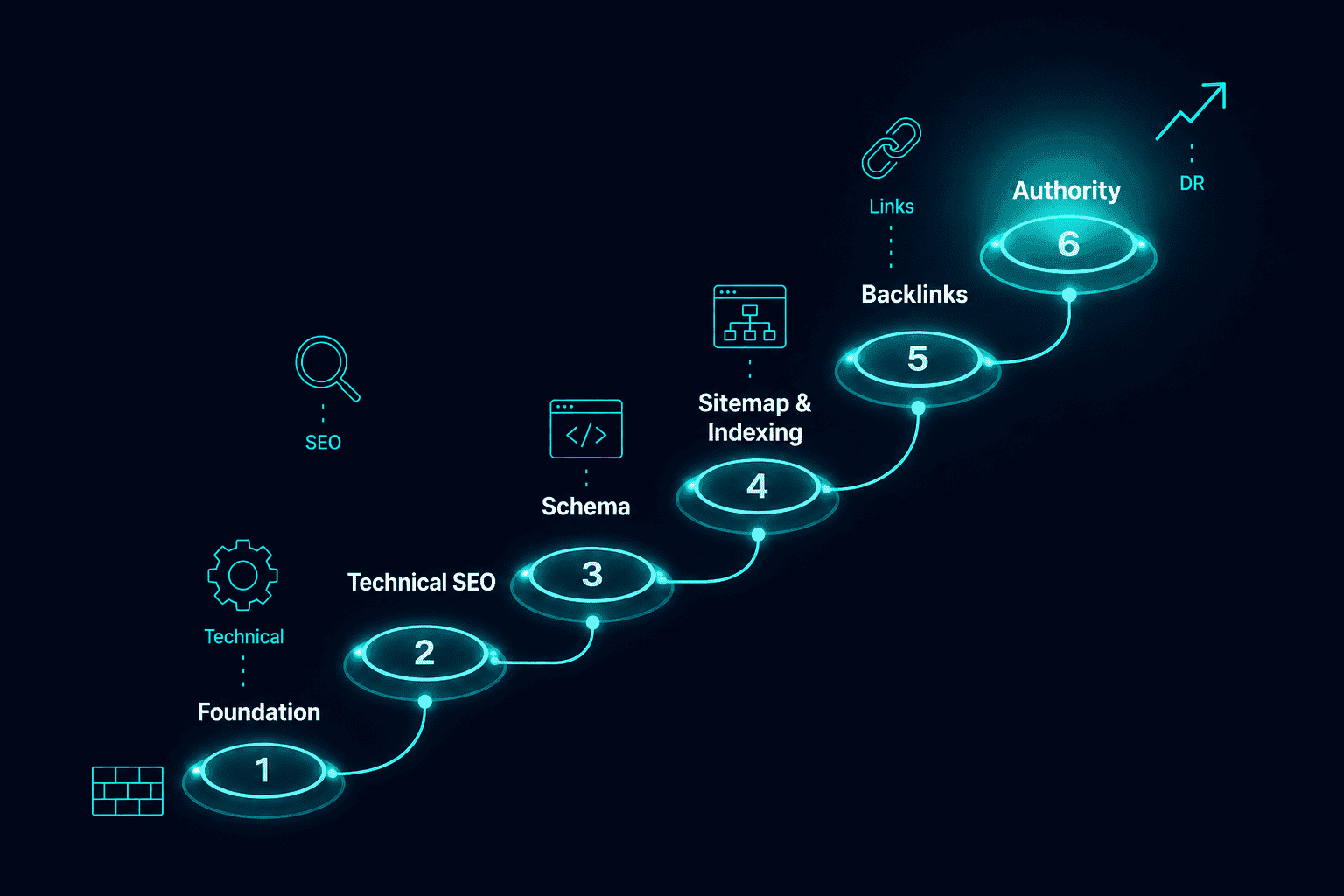
| Phase | Focus | Core steps |
|---|---|---|
| 1. Foundation | Build it right from day one | Website setup, keyword research, content plan |
| 2. Technical SEO | Make sure Google can read you | Crawlability, Core Web Vitals, mobile, redirects |
| 3. Structured data | Look right everywhere you appear | JSON-LD, OG images, image compression |
| 4. Discovery | Help search & AI crawlers find you | Sitemap, robots.txt, llms.txt, human sitemap, Search Console, RSS |
| 5. Authority | Earn trust off-site | Backlinks, topical authority, scaling links, DR growth |
| 6. Maintain | Keep what you built | Track rankings, refresh old posts, repeat the loop |
Phase 1: Get the foundation right
Everything downstream depends on this. Skip it and you'll spend the next two years fixing structural problems instead of growing.
- Build the website on clean architecture — simple URL structure, mobile-first layout, fast hosting, HTTPS from day one.
- Do keyword research before writing anything. Find what people actually search for, then group those terms into topics you can realistically rank for early on.
- Plan a content structure — pillar pages plus supporting posts — so your internal links have somewhere real to point.
Phase 2: Fix technical SEO before anything else
Structured data and backlinks can't rescue a site Google struggles to crawl or a page that loads slowly on mobile.
- Crawlability & indexing — make sure Google can actually reach and read every page you care about; check for accidental noindex tags and orphaned pages.
- Core Web Vitals — LCP, INP, and CLS. A slow site quietly caps your rankings before content quality even gets considered.
- Mobile usability — Google indexes mobile-first, so if a page breaks on a phone, it breaks your rankings too.
- Clean redirects and links — no redirect chains, no broken internal links, canonical tags pointing to the right URL.
Phase 3: Structured data and sharing
This is how you look right in search results and when a link gets shared, instead of showing up as a blank card.
- JSON-LD schema — Organization and Article/BlogPosting schema sitewide, plus SoftwareApplication schema on app pages and FAQ schema where it fits naturally.
- Open Graph images — give every post and app page its own OG image, or it looks broken when shared on WhatsApp, X, or LinkedIn.
- Compress images — convert to WebP or AVIF, lazy-load anything below the fold, and write real alt text instead of leaving it blank.
Phase 4: Help search engines and AI crawlers find everything
This step gets rushed constantly, but a page nobody can find might as well not exist.
- XML sitemap — auto-generated and updated automatically whenever you publish.
- robots.txt — tell crawlers what to skip (admin routes, duplicate parameters) without accidentally blocking the whole site.
- llms.txt — a newer file that gives AI crawlers like ChatGPT, Perplexity, and Claude a clean summary of what your site actually contains.
- Human-readable sitemap — an actual page listing your posts and apps, useful for visitors and for extra internal linking.
- Search Console — verify the property, submit your sitemap, and check coverage and performance weekly. Do the same in Bing Webmaster Tools while you're at it.
- RSS feed — helps posts get picked up by feed readers and some aggregators, and signals freshness.
Phase 5: Build real authority off-site
Nothing in the earlier phases earns rankings by itself — it just removes the reasons Google would ignore you. Authority is what actually moves you up.
- Backlinks — start with relevant, real links: guest posts on related blogs, honest directory listings, genuine partnerships. Quality beats volume every time.
- Topical authority — publish a cluster of related posts around each topic, all interlinked, so Google reads the site as a real source rather than one lucky page.
- Scale backlinks steadily — keep the pace natural. A sudden spike looks manufactured and can trigger a manual review instead of a ranking boost.
- Watch Domain Rating rise on its own — DR is a byproduct of link quality and quantity, not something to chase directly. Chase the links; DR follows.
Phase 6: Maintain and measure
SEO doesn't end at "done." Track rankings and traffic every month, refresh older posts that start slipping, and keep repeating the content-plus-backlink loop. The sites that keep growing are the ones that never fully stop.
Related
This is the same roadmap I use across every app and post on my own site. Browse muhammadhuzaifa.com to see it applied, or set up Google Search Console if you haven't already.
SEO rewards patience more than tricks. Get the technical layer right, make yourself easy to find, and let backlinks build up naturally — the rankings follow.